In a nutshell
Your immune system has to answer one question about every cell it meets: is this me, or not me? It reads the molecules on a cell's surface to decide.
This subtopic is about how that recognition works, how white blood cells respond to anything "foreign", and how we use that response in vaccines, antibody medicines and diagnostic tests.
Assumed knowledge: Cell structure, Proteins.
Core content
Antigens and recognising self from non-self
Every cell carries specific molecules on its surface that identify it. Many of these molecules are proteins, and their precise shapes let the immune system tell your own cells apart from anything foreign.
These surface molecules let the immune system identify:
- pathogens (organisms that cause disease, e.g. bacteria and viruses)
- cells from other organisms of the same species (why transplants can be rejected)
- abnormal body cells (e.g. cancerous or virus-infected cells)
- toxins (poisonous molecules, e.g. those released by some bacteria).
An antigen is a molecule, usually a protein, found on a cell surface that stimulates an immune response, leading to the production of an antibody. A molecule counts as an antigen because it triggers a response, not because of what it is made of.
Antigen variability
The antigens on a pathogen are coded for by its DNA (or RNA). A mutation changes the base sequence, which can change the antigen's shape. This is antigenic variability.
Why it matters for disease and its prevention:
- Memory cells and antibodies made against the old antigen are no longer complementary to the changed antigen, so they cannot bind it.
- You are no longer immune, so you can catch the "same" disease again (this is why influenza keeps returning and its vaccine is reformulated each year).
- It makes a lasting vaccine hard to develop.
Phagocytosis (a non-specific response)
Phagocytes (a type of white blood cell) engulf and destroy pathogens. This happens the same way whatever the pathogen, so it is non-specific and fast.
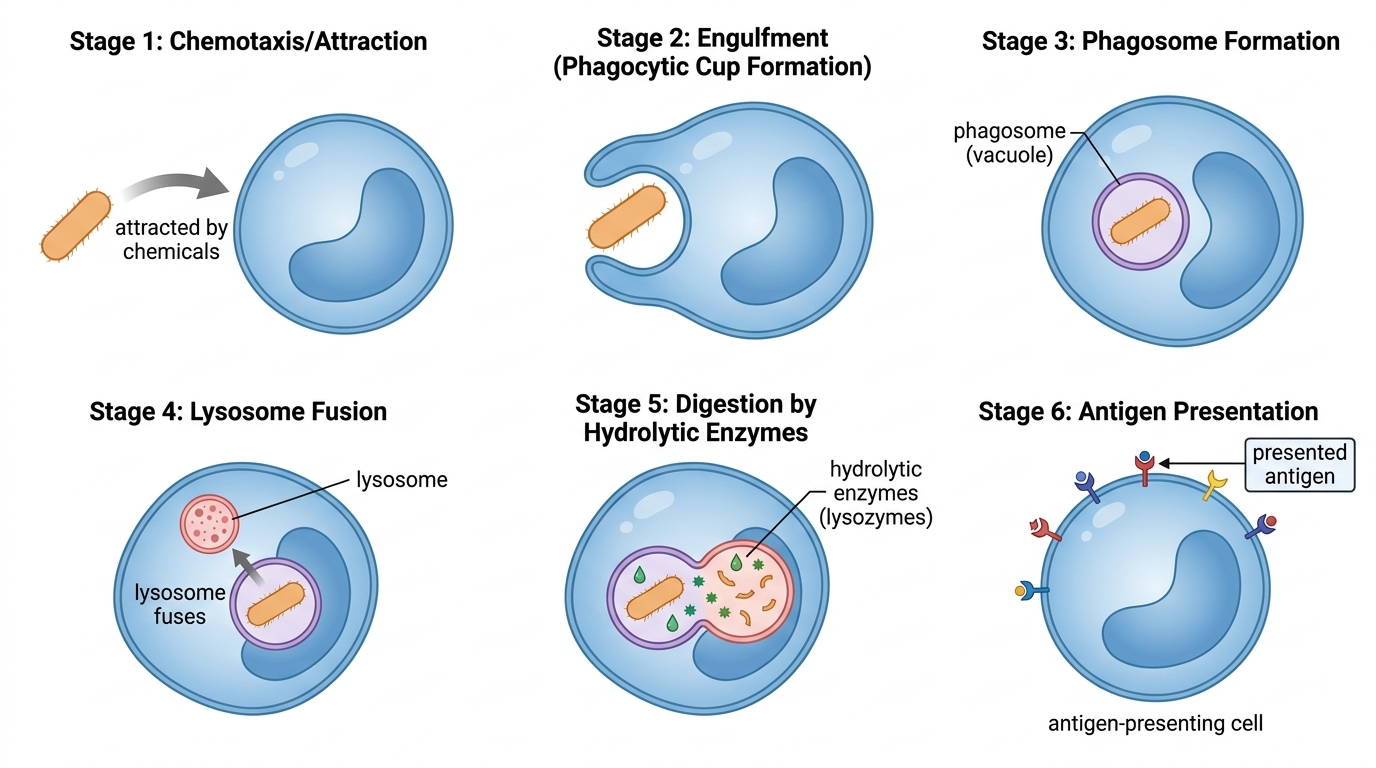
The sequence, in the words the marks are given for:
- The phagocyte is attracted to the pathogen by chemicals, and recognises the antigens on the pathogen as foreign.
- The phagocyte engulfs the pathogen.
- The pathogen is enclosed in a vesicle called a phagosome (a vacuole).
- A lysosome fuses with the phagosome.
- The lysosome releases hydrolytic enzymes (lysozymes) that digest (hydrolyse) the pathogen.
Afterwards the phagocyte displays the pathogen's antigens on its own cell-surface membrane. It has become an antigen-presenting cell, and this is what starts the specific response below.
The cellular response: T lymphocytes
The specific response is slower but targeted, and comes in two linked parts. The cellular response involves T lymphocytes (T cells) and responds to antigens presented on a cell's surface.
- An antigen-presenting cell displays the foreign antigen on its cell-surface membrane.
- A helper T cell (TH cell) with a complementary receptor binds to that antigen.
- This activates the helper T cell to divide by mitosis into a clone of identical cells.
The role of helper T cells is to stimulate:
- cytotoxic T cells (TC cells), which kill abnormal and virus-infected cells (they release a protein, perforin, that makes holes in the cell-surface membrane so the cell dies)
- B cells (which drives the humoral response below)
- phagocytes (increasing phagocytosis).
It is called the cellular response because it acts through cells rather than through antibodies dissolved in the blood.
The humoral response: B lymphocytes and clonal selection
The humoral response involves B lymphocytes (B cells) and produces antibodies that circulate in the blood and tissue fluid ("humour" means body fluid).
Each B cell carries a different antibody on its surface, specific to one antigen.
- A B cell whose surface antibody is complementary to the antigen binds to it.
- A helper T cell stimulates this specific B cell. This picking-out of the one right B cell is clonal selection.
- The B cell divides by mitosis to form a clone of identical cells (clonal expansion).
- The clone develops into plasma cells and memory cells.
- Plasma cells secrete large amounts of the specific antibody, all identical (this is why they are called monoclonal antibodies).
Still don't get it? · clonal selection
Imagine a locksmith with a wall of millions of different keys, made in advance, one for every lock that could ever turn up. A burglar arrives with one particular lock. The locksmith does not file a new key on the spot; they walk along the wall, find the single key that already fits, and then rush that one key to a photocopier to make thousands of copies.
Now the biology, one step at a time:
- Your body makes a huge variety of B cells before it ever meets a pathogen. Each B cell already carries one specific antibody on its surface, and between them they cover almost any antigen.
- When a pathogen arrives, its antigen only fits the one B cell whose antibody is complementary. That B cell is "selected". Nothing new is invented; the right cell was already there.
- That selected B cell is then copied over and over by mitosis (the photocopier), giving a clone of identical plasma cells that all pour out the same antibody.
Back to the exam wording: the antigen selects the B cell with the complementary antibody, that B cell divides by mitosis to form a clone, and the clone forms plasma cells that release a monoclonal antibody. That is clonal selection, and it is the point examiners want stated in that order.
Antibody structure
An antibody is a protein with a quaternary structure: four polypeptide chains (two long "heavy" chains and two short "light" chains) held together by disulfide bonds.
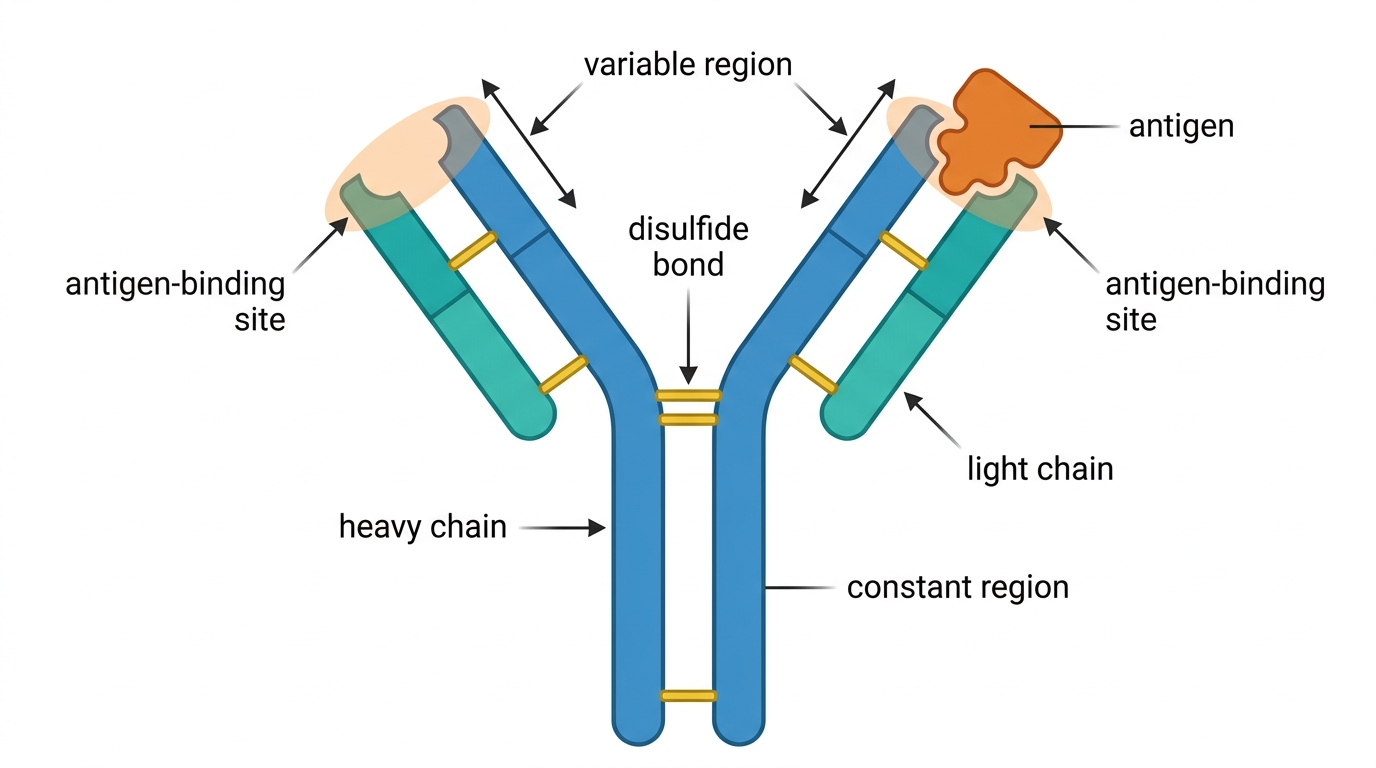
- The variable regions at the two tips have a different amino acid sequence in every antibody, so their tertiary structure forms binding sites with a shape complementary to one specific antigen.
- The constant region is the same in a given class of antibody.
- Because an antibody has two binding sites, it can bind two antigens at once.
The antigen-antibody complex, agglutination and destruction
When an antibody's binding site binds a complementary antigen, they form an antigen-antibody complex.
Because each antibody has two binding sites, one antibody can bind two pathogens, so many antibodies clump pathogens together. This clumping is agglutination.
Agglutination leads to destruction (the specification limits this to agglutination and phagocytosis of bacterial cells):
- Clumped pathogens cannot spread as easily.
- A single phagocyte can engulf many pathogens at once, so phagocytosis destroys them more efficiently.
Primary and secondary immune responses
The first time you meet an antigen, only a few B cells are complementary to it, so the response is slow and antibody levels stay low. This primary response is why you often feel ill on a first infection. Crucially, it produces memory cells.
On a second exposure to the same antigen, memory cells divide rapidly into plasma cells. The secondary response produces antibody faster and in much higher concentration, destroying the pathogen before symptoms appear. You are now immune.
The secondary response is faster, larger and longer-lasting than the primary response. That difference is the whole point of a vaccine.
Vaccination and herd immunity
A vaccine contains antigens (from a dead, weakened or harmless form of a pathogen, or the isolated antigen itself). It makes the immune system respond and produce memory cells without causing the disease.
If the real pathogen infects you later, the memory cells trigger a rapid secondary response, so you do not become ill.
Herd immunity is the protection a population gains when a large enough proportion of it is immune (usually through vaccination):
- there are fewer people in whom the pathogen can survive and reproduce, so it spreads far less
- there is less contact between infected people and people who are not immune
- this protects even the people who are not vaccinated (for example, babies or people who are too ill to be vaccinated).
Still don't get it? · herd immunity
Picture a forest fire trying to spread across a wood. If nearly every tree is dry, the fire jumps from tree to tree and reaches everything. But if most of the trees are soaked with water, the fire keeps hitting a wet tree, has nowhere to jump, and fizzles out, so even the few dry trees are usually spared.
Now rebuild the idea:
- A pathogen spreads by passing from an infected person to a susceptible (non-immune) person, like the fire jumping to a dry tree.
- Vaccinating most people is like soaking most of the trees. An infected person is now mostly surrounded by immune people the pathogen cannot infect, so the chain of transmission breaks.
- The unvaccinated few are protected not because they are immune, but because the pathogen can rarely reach them.
Exam wording to land on: when a high proportion of the population is vaccinated/immune, the pathogen cannot spread easily because there are fewer susceptible hosts and less contact between infected and non-immune people, so even unvaccinated individuals are protected. Avoid the word "resistance", and do not say unvaccinated people are all infected: those are the two phrasings examiners reject.
Active and passive immunity
Both make you immune, but only one lasts.
| Feature | Active immunity | Passive immunity |
|---|---|---|
| Source of antibody | your own body makes the antibody | antibody is introduced from outside the body |
| Antigen needed? | yes, exposure to the antigen is required | no direct exposure to the antigen |
| Memory cells? | yes | no |
| Speed | slow to develop | fast-acting |
| Duration | long-term (antibody made continuously in response to the antigen) | short-term (the introduced antibody is broken down) |
| Examples | infection; vaccination | antibodies across the placenta or in breast milk; an anti-venom injection |
The examiner's key point is that these must be given as a comparison: active involves memory cells and is long-term because the body keeps making antibody; passive has no memory cells and is short-term because the introduced antibody is broken down.
HIV and AIDS
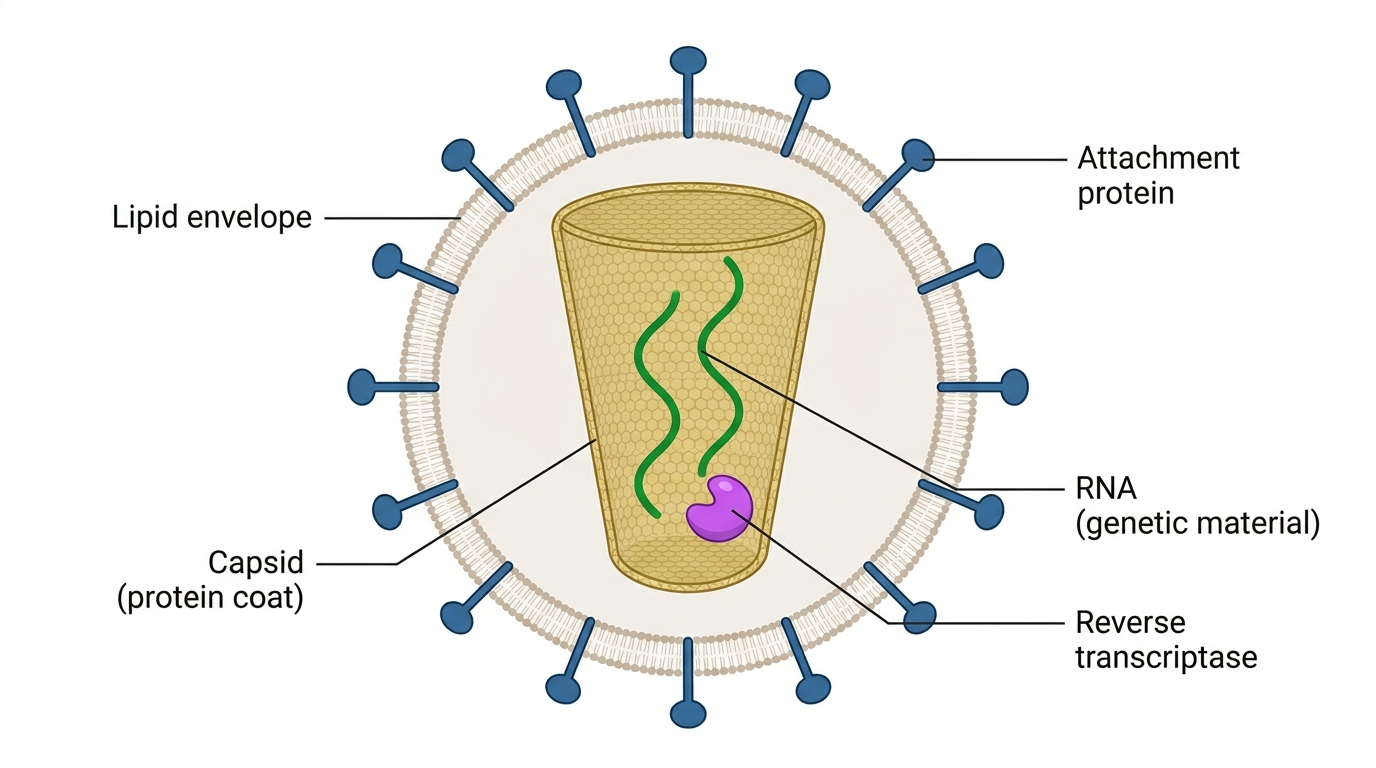
HIV (human immunodeficiency virus) is built from:
- two strands of RNA (its genetic material) and the enzyme reverse transcriptase
- surrounded by a protein capsid
- enclosed in a lipid envelope studded with attachment proteins.
Replication in helper T cells:
- An attachment protein on HIV binds to a receptor (CD4) on the helper T cell, and HIV enters the cell.
- Reverse transcriptase makes a DNA copy of the viral RNA.
- This DNA is inserted into the host cell's DNA.
- The host cell's machinery is used to make viral proteins and new viral RNA.
- New HIV particles assemble and bud off from the cell, ready to infect more helper T cells.
How HIV causes the symptoms of AIDS: HIV kills or disables helper T cells, so their number falls. Without enough helper T cells, the immune system cannot stimulate cytotoxic T cells, B cells and phagocytes properly, so it can no longer fight infection. The person then suffers from opportunistic (secondary) infections and cancers, which are the symptoms of AIDS.
Why antibiotics do not work against viruses: antibiotics target features of bacteria, such as their murein cell wall, their ribosomes or their metabolic enzymes. Viruses have none of these structures and no metabolism of their own (they use the host cell's), and they are hidden inside host cells, so an antibiotic has nothing to act on.
Monoclonal antibodies
A monoclonal antibody is an antibody produced from a single clone of plasma cells, so every molecule is identical and binds to one specific antigen. That precise targeting is what makes them useful (details of how they are produced are not required).
Targeting medication to specific cells:
- A therapeutic drug is attached to a monoclonal antibody.
- The antibody binds only to the specific antigen on the target cells (for example, an antigen found on cancer cells).
- The drug is delivered directly to those cells, so healthy cells are affected far less.
Medical diagnosis:
- A monoclonal antibody is made that is complementary to a specific antigen linked to a disease.
- Because it binds only that antigen, it can be used to detect the presence of the antigen (for example in pregnancy tests, or to identify a specific pathogen or type of cancer).
The ELISA test
The ELISA test (enzyme-linked immunosorbent assay) uses antibodies to detect and measure the amount of a specific antigen (or antibody) in a sample.
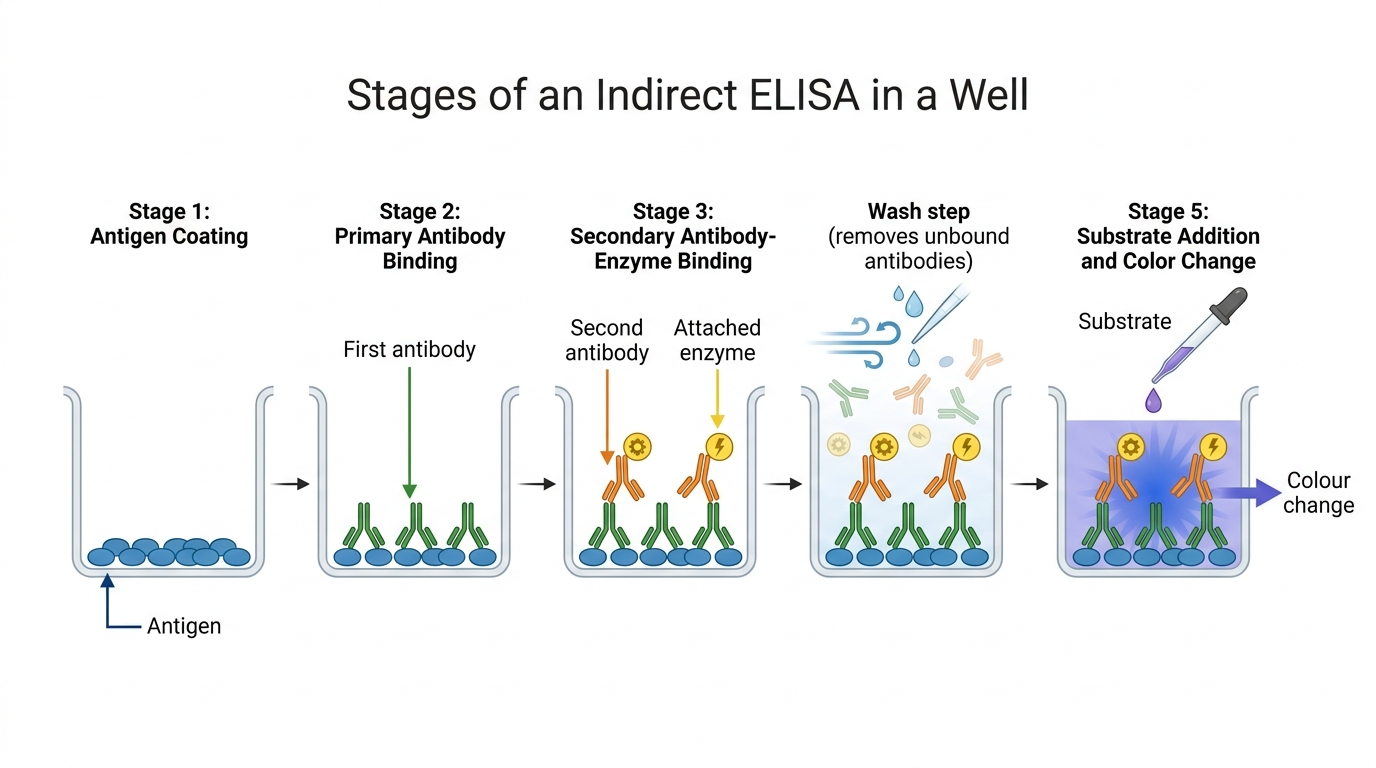
The principle, in stages:
- The antigen from the sample is bound to a surface (the bottom of a well).
- An antibody complementary to the antigen is added and binds to it.
- A second antibody, with an enzyme attached, is added and binds.
- The well is washed to remove any unbound antibody, so only antibody bound to the antigen remains.
- A substrate is added; the enzyme converts it and produces a colour change.
The intensity of the colour shows how much antigen is present. No colour change means the antigen is absent.
Ethical issues (vaccines and monoclonal antibodies)
You are expected to discuss ethical issues and evaluate the evidence and data rather than just list facts. Useful points to weigh:
- Vaccines and antibody drugs are usually tested on animals first, and monoclonal antibodies are often produced using animals, raising animal-welfare concerns.
- Testing on humans carries risk to volunteers, and there is debate over who should be tested and how side-effects are reported.
- Deciding who is vaccinated first, or whether vaccination should be compulsory, involves balancing individual choice against protecting the population through herd immunity.
- When you evaluate a study, look at sample size, controls and whether the data actually support the claim made about the vaccine or drug.
Worked examples
Model 5-mark answer: "Describe how the body responds to a vaccine containing antigens from a pathogen."
A full-mark answer needs the events in the right order. Number of distinct points needed: five.
- The antigen is displayed on an antigen-presenting cell.
- A helper T cell with a complementary receptor binds to the antigen and stimulates a specific B cell.
- The B cell whose surface antibody is complementary to the antigen is selected (clonal selection).
- The B cell divides by mitosis to form a clone of plasma cells and memory cells.
- Plasma cells release large amounts of the specific antibody, and memory cells remain to give a rapid secondary response on future infection.
Model 3-mark answer: "Explain why a person is protected on a second infection but not the first."
- On the first exposure the primary response is slow because few B cells are complementary to the antigen, so symptoms appear.
- The first response produces memory cells.
- On the second exposure, memory cells produce antibody faster and in higher concentration (the secondary response), destroying the pathogen before symptoms develop.
Common exam mistakes
- Saying a vaccine contains antibodies. A vaccine contains antigens; your body then makes the antibodies.
- Writing that a vaccine with more antigens gives "more antibodies". The mark needs the idea of different antigens, each producing a different specific antibody.
- Being vague about phagocytosis: not stating that a lysosome fuses with the phagosome, not saying the enzymes are hydrolytic, or saying the pathogen is "destroyed" instead of digested/hydrolysed.
- Confusing lysosome (the organelle) with lysozyme (a hydrolytic enzyme). The lysosome fuses; the lysozymes digest.
- Forgetting that the antigen is presented on the cell-surface membrane of the phagocyte.
- Giving an antibody an "active site" or an "enzyme-substrate complex". Antibodies have a binding site / variable region and form an antigen-antibody complex; they are not enzymes.
- Saying T cells produce antibodies. Antibodies are made by plasma cells (from B cells).
- Writing that "HIV becomes AIDS". HIV is the virus; AIDS is the condition caused when helper T cell numbers fall too low.
- Saying HIV "is killed", is a "bacterium", or "binds to reverse transcriptase". HIV binds via its attachment protein to a receptor on the helper T cell; reverse transcriptase is HIV's own enzyme, used inside the cell.
- Describing herd immunity with the word "resistance", or assuming all unvaccinated people are infected. Say instead that fewer susceptible hosts and less contact stop the pathogen spreading.
- Saying "the body becomes immune to an antibiotic". It is the bacterium that becomes resistant; the body does not become immune to a drug.
- Not making active vs passive comparative: say long-term because antibody is made in response to the antigen vs short-term because the introduced antibody is broken down.
Key definitions
- Antigen: a molecule (usually a protein) on a cell surface that stimulates an immune response, leading to the production of an antibody.
- Antibody: a protein, produced by B lymphocytes (plasma cells) in response to a specific antigen, with a variable region (binding site) complementary to that antigen.
- Antigen-antibody complex: the structure formed when an antibody binds to its complementary antigen.
- Antigenic variability: the change in a pathogen's antigens caused by mutation, so that antibodies and memory cells from a previous infection are no longer complementary.
- Phagocytosis: the engulfing of a pathogen by a phagocyte, which is then digested by hydrolytic enzymes from a lysosome.
- Clonal selection: the selection of the B cell (or T cell) with the receptor/antibody complementary to a specific antigen, which then divides to form a clone.
- Active immunity: immunity gained when the immune system makes its own antibodies after exposure to an antigen.
- Passive immunity: immunity gained from antibodies introduced into the body from an outside source, not made by the body itself.
- Vaccine: a preparation containing antigens that stimulates an immune response and the formation of memory cells without causing the disease.
- Herd immunity: the protection of a population, including unvaccinated individuals, that arises when a large enough proportion of it is immune so the pathogen cannot spread easily.
- Monoclonal antibody: an antibody produced from a single clone of plasma cells, so all the molecules are identical and specific to one antigen.
Specification
- I can state that each cell type has specific molecules (including proteins) on its surface, and that these let the immune system identify pathogens, cells from other organisms of the same species, abnormal body cells and toxins.
- I can define an antigen.
- I can explain the effect of antigen variability on disease and disease prevention.
- I can describe phagocytosis and the destruction of ingested pathogens by lysozymes.
- I can describe the response of T lymphocytes to a foreign antigen (the cellular response), including the role of antigen-presenting cells and of helper T cells in stimulating cytotoxic T cells, B cells and phagocytes.
- I can describe the response of B lymphocytes, clonal selection, and the release of monoclonal antibodies (the humoral response).
- I can define an antibody and describe antibody structure.
- I can explain how an antigen-antibody complex leads to destruction of the antigen by agglutination and phagocytosis of bacterial cells.
- I can explain the roles of plasma cells and memory cells in the primary and secondary immune responses.
- I can explain the use of vaccines for individuals and populations, and the concept of herd immunity.
- I can state the differences between active and passive immunity.
- I can describe the structure of HIV and its replication in helper T cells.
- I can explain how HIV causes the symptoms of AIDS, and why antibiotics are ineffective against viruses.
- I can describe the use of monoclonal antibodies in targeting medication and in medical diagnosis.
- I can describe the use of antibodies in the ELISA test.
- I can discuss ethical issues, and evaluate evidence and data, relating to vaccines and monoclonal antibodies.
Related notes
Ready to test yourself?
Put Cell recognition and the immune system into practice with exam-style questions and full mark schemes.
Practise Cell recognition and the immune system